
“Free Money” or Public School Heist? The Truth About Federal School Vouchers


The Trump White House is selling the federal school voucher scheme as a historic
opportunity for “school choice and education freedom.” This first ever federal school voucher is being marketed as “free money,” with the stipulation that the money must be allocated to organizations that give scholarships (vouchers) to students.
Who is this “free money” for and what effect will it have on statutory federal programs? Beginning in 2027 in states that opt in, the “Education Freedom Act” includes a $1700 tax credit for scholarships, “empowering families to choose the best schools for their children in all 50 states.”
In reality, this scheme moves taxpayer money to private and religious schools with no accountability to taxpayers required–no oversight, no guardrails against waste and fraud, no academic standards, no civil rights protections. The additional stipulation that money could be used for tutoring and after school expenses for public school students is totally dependent on the organizations that receive the taxpayer money.
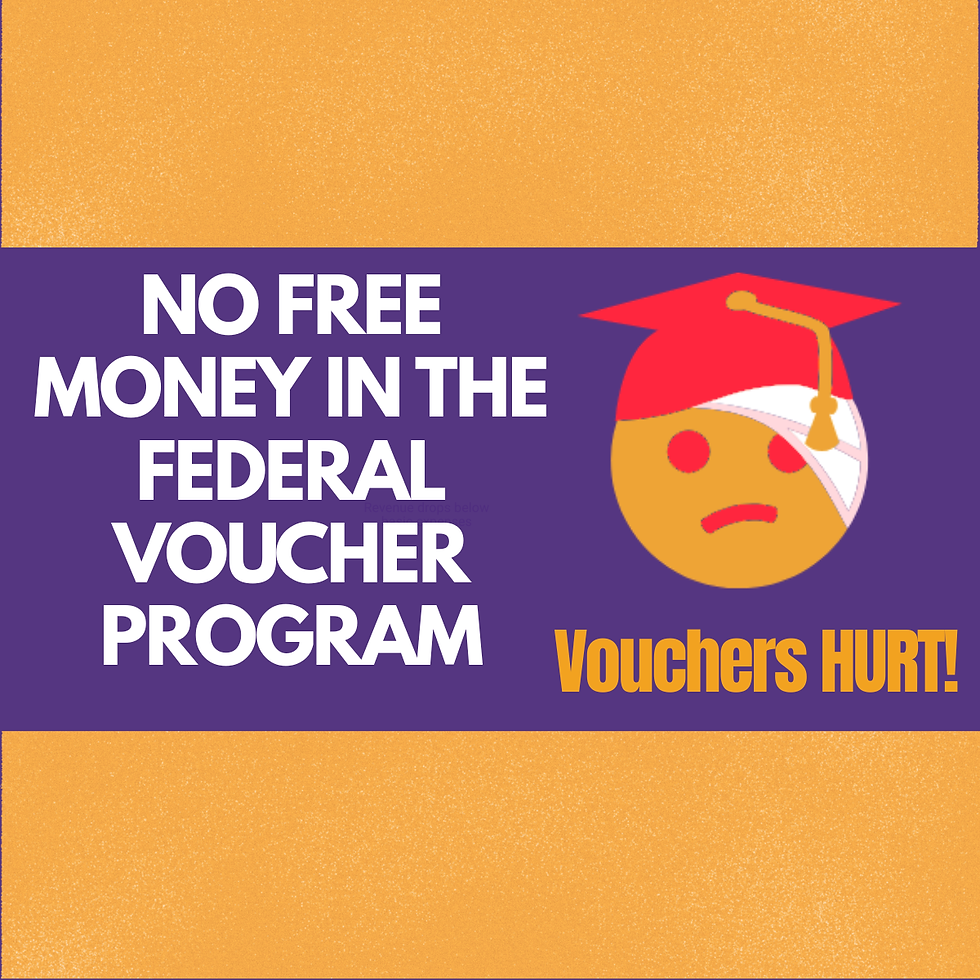
There is no such thing as free money!
For years, the federal government has not adequately funded its current obligations to the public schools that serve 80-85% of the student population. The cost of this voucher program is estimated to be at least $26 billion in the first year. If that money was instead invested by the federal government to support students in under-funded public schools, it would have a profound positive impact. By even the lowest estimates, this “school choice” plan will ultimately add $260 billion to the federal budget deficit over 10 years.
What if the $26 billion was added to IDEA-Individuals with Disabilities Education Act? |
The federal government agreed to cover 40% of the excess costs for special education services to assist with the high cost of addressing the needs of students with disabilities. The federal government, however, has never met that promise. Current funding at $14.2 billion amounts to much less than 12% of the promise. Adding $26 billion to IDEA would almost triple current funding and completely pay for the federal funding obligation to IDEA. |
What if $26 billion was added to Title 1?
Currently funded at $18.4 billion, increasing Title 1 funding by $26 billion would provide the support needed to address the persistent achievement gap that often exists for children from low-income families. This federal tax credit voucher program will likely do the opposite. Research shows that private school voucher programs disproportionately benefit the wealthy.
Project 2025, the Trump administration’s playbook, calls for eliminating funding for Title1. Lindsey Burke, education author for Project 2025, predicts that a “majority of kids will be in a private school choice program” in a few years.
Will society support subsidizing private education for the wealthy or meeting the needs of all children, especially those with disabilities or living in poverty?


Comments